
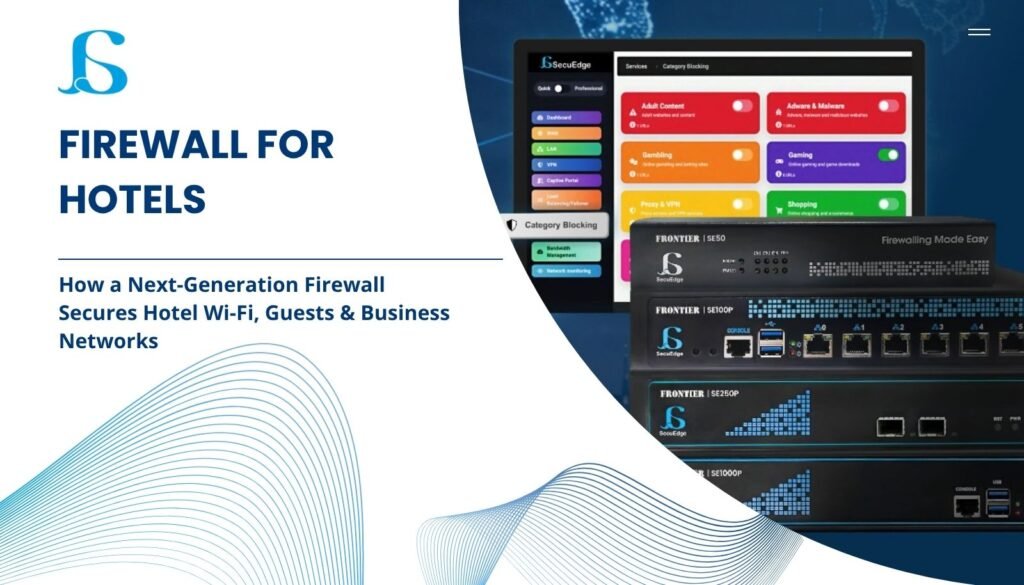
Firewall for Hotels: How a Next-Generation Firewall Secures Hotel WiFi, Guests & Business Networks
Hotels are no longer just hospitality businesses—they are highly connected digital environments. From guest WiFi and online bookings to CCTV cameras, smart TVs, POS terminals, staff devices, payment systems, and property management software, almost every part of hotel operations depends on a reliable and secure network.
This creates an important question for hotel owners and IT administrators:
What is the best way to protect a hotel network without affecting guest experience or business operations?
The answer starts with choosing the right firewall for hotels.
A modern hotel needs more than a traditional firewall that simply allows or blocks traffic based on basic rules. Hotels need visibility into network activity, application control, web filtering, threat prevention, bandwidth management, and secure segmentation between guests, employees, and critical hotel systems.
A Next-Generation Firewall (NGFW) can help hotels create a safer, more controlled, and more reliable network environment while maintaining the fast WiFi experience guests expect.
Why Do Hotels Need a Firewall?
Hotel networks are different from normal office networks.
A corporate office may have a relatively predictable number of employees and devices. A hotel, however, can have hundreds of guests connecting from personal smartphones, laptops, tablets, smart TVs, and other devices every day.
At the same time, the hotel’s internal network may contain highly important systems such as:
-
- Property Management Systems (PMS)
-
- Online booking systems
-
- POS and payment systems
-
- CCTV and surveillance systems
-
- Access control systems
-
- Staff computers
-
- VoIP systems
-
- Smart TVs and IoT devices
-
- Printers and other network devices
-
- Administrative systems
-
- Guest WiFi infrastructure
If all these devices and users operate without proper network security controls, one compromised device can potentially become a security risk for other parts of the network.
This is why a firewall solution for hotels should not be considered only an IT expense. It should be treated as part of the hotel’s overall operational and cybersecurity infrastructure.
Common Hotel WiFi Problems That Hotel Owners Face
Before choosing a firewall for hotel WiFi, hotel owners should understand the actual problems occurring on their network.
1. Guest WiFi Consuming Excessive Bandwidth
One of the most common complaints in hotels is slow WiFi.
A few users may consume a significant amount of bandwidth through:
-
- HD/4K video streaming
-
- Large downloads
-
- Cloud backups
-
- Gaming
-
- Video conferencing
-
- Torrent traffic
-
- Software updates
As a result, other guests may experience slow internet even though the hotel has purchased a high-speed internet connection.
A properly configured NGFW can help with application visibility, traffic control and bandwidth policies so that network resources can be managed more effectively.
2. Uncontrolled Guest Internet Access
Hotels generally want to provide convenient internet access, but unrestricted access can create security and operational challenges.
Hotel management may want to restrict or monitor categories such as:
-
- Malware and phishing websites
-
- Dangerous downloads
-
- Gambling
-
- Adult content
-
- Malicious domains
-
- Suspicious applications
-
- High-risk websites
A modern hotel firewall can support web and application filtering policies to create a safer browsing environment.
3. Guest Devices Should Not Access Internal Systems
Imagine a guest connects a personal laptop to the hotel’s WiFi.
That device should not be able to communicate directly with:
-
- Hotel billing systems
-
- POS terminals
-
- Staff computers
-
- CCTV systems
-
- Administrative servers
-
- Property management systems
This is where network segmentation becomes extremely important.
A hotel can create separate security zones for guest WiFi, staff devices, servers, CCTV, IoT devices and other critical systems.
The objective is simple:
Guests should get internet access—not access to the hotel’s internal infrastructure.
4. Unknown Devices Connecting to the Network
A hotel network may have hundreds or thousands of connected devices over time.
Without sufficient visibility, IT teams may struggle to understand:
-
- Which devices are connected?
-
- Which applications are being used?
-
- Which websites are being accessed?
-
- How much bandwidth is being consumed?
-
- Which devices are generating suspicious traffic?
-
- Are unknown devices communicating with sensitive systems?
This makes visibility an essential part of hotel network security.
5. Cyber Threats Against Hotel Networks
Hotels are attractive targets for cybercriminals because they manage large amounts of digital information and operate many connected systems.
Potential threats include:
-
- Malware
-
- Phishing
-
- Ransomware
-
- Botnet activity
-
- Exploitation attempts
-
- Malicious downloads
-
- Unauthorized access
-
- Data theft
-
- Denial-of-service attacks
A traditional firewall may not provide the level of application awareness, threat detection and traffic inspection that modern hotel environments require.
This is where a Next-Generation Firewall for hotels becomes valuable.
What Is a Next-Generation Firewall?
A Next-Generation Firewall is an advanced network security solution designed to provide more visibility and control than traditional firewall technology.
Instead of looking only at IP addresses and ports, an NGFW can provide deeper inspection and policy control depending on its capabilities and configuration.
For hotels, useful NGFW capabilities can include:
-
- Application control
-
- Web filtering
-
- Intrusion prevention
-
- Malware and threat prevention
-
- User and device visibility
-
- Bandwidth management
-
- VPN security
-
- Network segmentation
-
- Traffic monitoring
-
- Access policies
-
- Reporting and logging
This makes an NGFW particularly suitable for environments where many different types of users and devices share the same internet infrastructure.
How a Firewall for Hotels Can Improve Guest WiFi
Guest WiFi is one of the most important customer-facing digital services in a hotel.
Guests expect WiFi to be:
Fast + Reliable + Secure + Easy to Access
A firewall sits between the hotel’s internal network and external internet traffic and can help the IT team establish appropriate policies.
For example, a hotel may create different policies for:
Guest Network
Internet access with controlled bandwidth and restricted access to internal resources.
Staff Network
Access to approved business applications and internal systems.
Management Network
Higher-level access to business-critical applications and administrative systems.
CCTV/IoT Network
Restricted communication with only the systems and services required for operation.
This approach reduces unnecessary communication between different parts of the network.
Hotel WiFi Security: Why Network Segmentation Matters
One of the biggest mistakes in hotel network design is treating every connected device as part of one large network.
Consider this scenario.
A guest connects an infected laptop to the hotel WiFi.
If the network is poorly segmented, that device could potentially attempt to communicate with other devices on the network.
Now consider a segmented environment.
The guest device is placed into the guest network.
The guest network can be configured to communicate with the internet while being isolated from sensitive hotel systems.
This security architecture can significantly reduce the potential attack surface.
Therefore, when evaluating a firewall for hotel WiFi, hotel owners should ask:
“Can the solution help us separate guest, staff, server, CCTV and IoT traffic?”
Why Hotel Owners Should Consider Application Control
Traditional internet filtering often focuses on websites or IP addresses.
But today’s applications can use multiple domains, dynamic infrastructure and encrypted connections.
Application-aware security can provide greater visibility into the types of applications consuming hotel bandwidth.
For example, management may want to understand whether bandwidth is being consumed by:
-
- Video streaming
-
- Social media
-
- Cloud storage
-
- Gaming
-
- Peer-to-peer applications
-
- Business applications
-
- Video conferencing
The objective is not necessarily to block everything.
Instead, hotel management can establish policies based on business requirements.
For example:
Business-critical applications → Priority access
Guest entertainment → Controlled bandwidth
High-risk applications → Restricted
This can help improve the overall guest internet experience.
Web Filtering for Hotels
Another important component of hotel cybersecurity is web filtering.
A hotel cannot control what every guest does online, but it can establish reasonable security policies for its network.
Web filtering can help prevent access to categories associated with:
-
- Phishing
-
- Malware
-
- Malicious downloads
-
- Fraudulent websites
-
- Adult content
-
- Gambling
-
- Other inappropriate or high-risk content
This is especially useful for hotels that want to maintain a safer network environment for guests and employees.
For staff networks, stricter policies can be implemented than those used for guest networks.
Protecting Hotel Business Systems
Guest WiFi is only one part of hotel network security.
A hotel also needs to protect systems that directly support daily operations.
These may include:
Property Management System
The PMS can contain important operational and guest-related information.
Point-of-Sale Systems
Restaurants, bars and other hotel outlets may depend on POS systems for transactions.
CCTV
Modern surveillance systems are increasingly connected to the network.
Access Control
Electronic locks and access control systems can also be network-connected.
Administrative Devices
Management and accounting teams may use computers connected to internal systems.
A properly designed firewall solution for hotels can help create security policies around these different environments.
Hotel Owner Questions: What Should I Look for in a Hotel Firewall?
Hotel owners often ask questions such as:
“What is the best firewall for a hotel?”
There is no single firewall that is best for every hotel.
The right solution depends on:
-
- Number of rooms
-
- Number of users
-
- Internet bandwidth
-
- Number of access points
-
- Number of connected devices
-
- Number of properties
-
- Required security features
-
- Existing network architecture
-
- Future growth
The key is to select a firewall that can handle the hotel’s current requirements while allowing room for future expansion.
“Can a firewall improve slow hotel WiFi?”
A firewall cannot increase the physical capacity of an internet connection.
However, an appropriately configured NGFW can help manage bandwidth, prioritize traffic, control applications and prevent unnecessary traffic from consuming network resources.
Therefore, it can contribute to a more controlled and consistent WiFi experience.
“Can I separate guest WiFi from hotel systems?”
Yes. Network segmentation is an important security practice.
Guest WiFi should ideally be separated from sensitive internal networks such as POS, PMS, CCTV, administrative systems and servers.
The exact architecture depends on the hotel’s network design.
“Can a firewall block adult content on hotel WiFi?”
Depending on the firewall’s filtering capabilities and configuration, web-category filtering can be used to restrict access to adult, malicious or other unwanted categories.
Hotels should define their acceptable-use policies and configure filtering accordingly.
“How can I stop guests from consuming all the bandwidth?”
Traffic visibility, application control and bandwidth policies can help hotel IT teams identify heavy traffic and establish appropriate limits or priorities.
“Do small hotels need an NGFW?”
A smaller hotel can still have significant security requirements because even a small property may operate guest WiFi, POS, CCTV, staff devices, smart TVs and other connected systems.
The appropriate firewall should be selected according to the hotel’s actual network size and risk profile rather than simply the number of rooms.
Secuedge Next-Generation Firewall for Hotels
For hotels looking to strengthen their network security, Secuedge Next-Generation Firewall can be positioned as a security layer between the hotel’s networks and the internet.
The objective is not simply to block unwanted traffic.
It is to provide hotel IT teams with greater control over how users, applications and devices interact with the network.
A hotel can design security policies around different network requirements, such as:
Guest WiFi → Controlled internet access
Staff Network → Business-focused access
Management Network → Restricted administrative access
CCTV/IoT → Isolated network communication
Servers → Strict access policies
This approach can help hotels move from a basic “internet connection” model toward a more structured hotel network security architecture.
For hotel management, the value of a firewall should ultimately be measured through questions such as:
-
- Can we control guest internet traffic?
-
- Can we protect critical internal systems?
-
- Can we identify suspicious network activity?
-
- Can we manage bandwidth?
-
- Can we restrict dangerous websites and applications?
-
- Can we separate guest and business networks?
-
- Can our security infrastructure scale as the hotel grows?
A properly deployed Secuedge NGFW can form an important part of that security strategy.
Firewall for Hotels: A Practical Deployment Approach
Hotels can consider implementing their firewall strategy in stages.
Step 1: Map the Hotel Network
Identify all important networks, devices and internet connections.
Step 2: Separate Critical Systems
Create appropriate segmentation between guest WiFi, staff systems, servers, CCTV, IoT and management networks.
Step 3: Define Internet Policies
Determine what guest users and employees should be allowed to access.
Step 4: Establish Bandwidth Policies
Identify bandwidth-heavy applications and create suitable controls.
Step 5: Enable Security Controls
Deploy relevant threat prevention, web filtering, application control and access policies.
Step 6: Monitor Network Activity
Regularly review traffic, applications, suspicious activity and bandwidth usage.
Step 7: Review and Update Policies
Hotel networks change continuously. New devices, applications, employees and services should be incorporated into the security strategy.
Why Hotel Cybersecurity Is Now a Business Priority
A hotel network failure can affect much more than the IT department.
If WiFi becomes unavailable, guests complain.
If POS systems stop working, transactions can be affected.
If CCTV becomes unavailable, security operations can be impacted.
If business systems are compromised, hotel operations can face significant disruption.
Therefore, cybersecurity should be viewed as part of business continuity and guest experience—not just a technical requirement.
A secure and well-managed network can support the hotel in delivering the connectivity guests expect while protecting the systems the business depends on.
Final Thoughts: Choosing the Right Firewall for Hotels
Hotels need to balance three priorities:
Guest Experience + Business Operations + Cybersecurity
A basic internet connection is not enough to achieve this balance.
With guests, employees, IoT devices, CCTV systems, POS terminals and business applications sharing the same overall infrastructure, hotels require visibility and control across their network.
A Next-Generation Firewall for hotels can help provide that control through capabilities such as application awareness, web filtering, traffic management, network segmentation and threat prevention.
For hotel owners and IT decision-makers, the most important question is therefore not simply:
“Which firewall should we buy?”
The better question is:
“How can we build a secure hotel network without compromising guest connectivity and business operations?”
That is where a properly planned Secuedge Next-Generation Firewall deployment can become part of a hotel’s broader cybersecurity strategy.
If your hotel is facing slow WiFi, uncontrolled bandwidth usage, unsafe browsing, guest-network security concerns, unauthorized access attempts or difficulty separating guest and business traffic, it may be time to evaluate your existing network security architecture.
Secure your hotel network. Protect your business. Give guests the connectivity they expect.
Frequently Asked Questions About Firewall for Hotels
1. What is a firewall for hotels?
A firewall for hotels is a network security solution designed to control and protect internet traffic between hotel networks and external networks. Modern NGFWs can also provide application control, web filtering, traffic monitoring, threat prevention and network segmentation.
2. Why do hotels need a firewall for guest WiFi?
Guest WiFi connects many unknown and unmanaged devices to the hotel’s network environment. A firewall can help control guest traffic, restrict access to internal systems, manage bandwidth and reduce exposure to malicious or unwanted internet traffic.
3. What is the best firewall for hotel WiFi?
The best firewall depends on the hotel’s size, bandwidth, number of users, network architecture, connected devices and security requirements. Hotels should evaluate firewall performance, scalability, segmentation, application control, web filtering and threat-prevention capabilities before making a decision.
4. Can a hotel firewall block adult content?
Depending on the firewall’s capabilities, web-category filtering can be configured to restrict access to adult content and other unwanted categories on selected hotel networks.
5. Can a firewall solve slow hotel WiFi?
A firewall cannot increase the bandwidth supplied by an ISP. However, it can help manage bandwidth, identify high-consumption applications, establish traffic policies and control unnecessary traffic, which can contribute to a more consistent WiFi experience.
6. Should guest WiFi and hotel systems be on separate networks?
Yes. Guest WiFi should generally be isolated from sensitive hotel systems such as POS, PMS, CCTV, servers and administrative devices. Network segmentation can reduce the risk of unauthorized communication between guest devices and critical systems.
7. Is an NGFW suitable for small hotels?
Yes, provided the firewall is appropriately sized for the hotel’s bandwidth, users, devices and security requirements. The number of hotel rooms alone should not determine the firewall requirement.
8. How can hotels improve their network security?
Hotels can improve security by using network segmentation, strong access controls, secure guest WiFi, web and application filtering, threat prevention, regular monitoring, updated systems and a properly configured next-generation firewall