
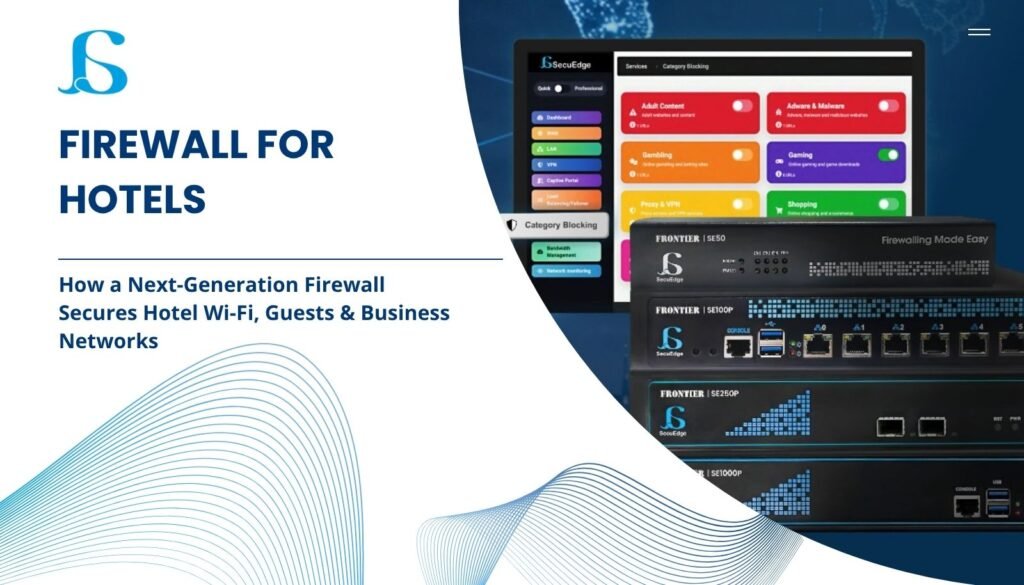
Firewall for Banking & Financial Services: Securing Financial Networks
Banks and financial institutions manage highly sensitive information, including customer identities, account details, payment data, and financial transactions. With digital banking, online payments, mobile applications, branch networks, ATMs, and cloud-based services becoming increasingly interconnected, protecting these environments from cyber threats has become essential. A next-generation firewall (NGFW) provides banks and financial institutions with centralized visibility, access control, traffic inspection, and threat prevention to help secure their critical network infrastructure.
Customers can open accounts, transfer money, make payments, apply for loans and manage investments without visiting a branch. Behind this convenience is a highly connected digital infrastructure involving banking applications, ATMs, payment systems, employee networks, cloud platforms, third-party services and remote users.
But greater connectivity also creates greater exposure.
A financial organization does not only have to protect its computers. It needs to protect transactions, customer information, internal applications, payment infrastructure and the network connecting them.
A single compromised endpoint or poorly controlled connection can potentially become the starting point for a much larger security incident.
This is why traditional perimeter security alone may no longer be enough.
A Next-Generation Firewall (NGFW) can provide an important layer of protection by combining traditional firewall controls with application awareness, intrusion prevention, traffic inspection, access control, visibility and other security capabilities.
For banks, NBFCs, fintech companies, insurance organizations and other financial institutions, the objective is not simply to block malicious traffic.
It is to build a network environment where legitimate users and applications can operate efficiently while unnecessary and potentially dangerous traffic is identified and controlled.
Why Banking and Financial Networks Need Stronger Security
Financial organizations operate in an environment where availability, confidentiality and trust are all critical.
A modern financial organization may have connections between:
- Core banking applications
- Branch offices
- ATMs
- Payment systems
- Employee workstations
- Customer-facing applications
- Mobile applications
- Cloud infrastructure
- Data centres
- Third-party vendors
- Remote employees
- Security systems
- Internal servers
This creates a complex network with many possible entry points.
At the same time, attackers have strong incentives to target financial organizations because financial data and access credentials can be highly valuable.
The challenge for IT and security teams is therefore twofold:
Protect critical systems while keeping financial services available to customers and employees.
A firewall plays an important role in this equation.
What Is a Next-Generation Firewall?
A Next-Generation Firewall is an advanced network security solution that goes beyond basic IP and port-based traffic filtering.
Traditional firewalls are useful for controlling network connections, but modern environments require greater visibility into what is actually happening on the network.
An NGFW can provide capabilities such as:
- Application awareness and control
- Intrusion prevention
- Web filtering
- User and device visibility
- Threat detection
- VPN security
- Network segmentation
- Traffic monitoring
- Security policy enforcement
- Reporting and analytics
The exact capabilities vary by product and deployment.
The important idea is that the firewall can provide greater context around network traffic.
Instead of seeing only:
“Device A is communicating with Server B.”
security teams can gain more information about:
“Which user or device is communicating, which application is involved, what resource is being accessed and whether the traffic matches the organization’s security policy.”
That additional context can make network security more effective and manageable.
8 Major Cybersecurity Challenges for Banking & Financial Services
- 1. Protecting Customer and Financial Data
Financial organizations handle highly sensitive information.
This may include:
- Customer account information
- Transaction records
- Payment information
- Personal information
- Employee data
- Authentication credentials
- Business and financial records
A security incident involving such information can have serious consequences.
Network security controls should therefore be designed to minimize unnecessary access to sensitive systems.
An NGFW can help enforce traffic policies between users, applications and different network segments.
- 2. Securing Online Banking and Digital Services
Customers increasingly expect financial services to be available 24/7.
Online banking portals, mobile applications and digital payment services have therefore become essential parts of financial infrastructure.
This creates an important security requirement:
Security controls must protect digital services without unnecessarily disrupting legitimate traffic.
A modern firewall can provide visibility into applications and network connections while allowing organizations to create policies based on business requirements.
3. Branch and Remote Office Connectivity
Banks and financial institutions may operate multiple branches and offices.
These locations need secure communication with central infrastructure.
The more locations an organization operates, the more important centralized policy management and monitoring become.
A Next-Generation Firewall can support secure connectivity between locations while helping security teams maintain consistent policies.
This can be particularly useful for organizations that are expanding their branch network or connecting distributed offices.
- 4. Employee and Endpoint Security
Employees interact with financial systems every day.
Their computers may access:
- Internal applications
- Customer information
- Cloud services
- Financial databases
- Third-party platforms
If an employee endpoint becomes compromised, attackers may attempt to use it as a pathway toward more valuable systems.
An NGFW can provide an additional network-level security layer by monitoring and controlling traffic leaving and entering internal environments.
This is important because endpoint security and network security should complement each other.
- 5. Third-Party and Vendor Access
Financial organizations often depend on external technology providers, service partners and vendors.
Third-party connectivity can improve operational efficiency, but it also introduces additional security considerations.
Organizations should carefully control:
- Who can connect
- Which systems they can access
- When access is allowed
- What traffic they can generate
Firewall policies and segmentation can help restrict third-party access to only the resources that are actually required.
- 6. Ransomware and Network-Based Threats
Ransomware and other malicious activities can disrupt business operations.
For financial organizations, downtime can quickly become a customer-facing issue.
Imagine a situation where employees cannot access critical internal applications or branches cannot communicate with central systems.
The impact could extend beyond the IT department.
A Next-Generation Firewall can contribute to a layered defence by inspecting traffic, enforcing policies and helping identify suspicious network behaviour.
It should not be considered a replacement for endpoint security, backup systems, identity security or incident response.
Instead, it forms an important part of the overall security architecture.
7. Increasing Use of Cloud Applications
Financial organizations increasingly use cloud-based applications and services.
This can improve scalability and accessibility, but it also changes the traditional network perimeter.
Users may access business applications from offices, branches, homes and mobile environments.
This makes visibility and policy enforcement increasingly important.
A modern firewall strategy should therefore consider not only the traditional data centre but also cloud connectivity, remote access and distributed users.
- 8. Lack of Network Visibility
A security team cannot effectively protect what it cannot see.
Organizations should understand:
- Which applications are being used
- Which devices are communicating externally
- Which connections are unusual
- Where high-risk traffic originates
- Which systems are exposed
- How network bandwidth is being consumed
This visibility can help security teams identify suspicious patterns and make better decisions.
A modern NGFW can provide useful network-level visibility that complements other security monitoring systems.
How a Next-Generation Firewall Helps Financial Organizations
A properly implemented NGFW can become an important security control point between the internet, users, applications and critical financial infrastructure.
A simplified architecture might look like:
Internet
↓
Next-Generation Firewall
↓
Secure Network Environment
↓
Segmented Applications & Systems
This architecture can support multiple security policies.
Customer-Facing Systems
Public-facing applications can be separated from internal systems where appropriate.
Employee Network
Employee devices can operate under controlled application and web-access policies.
Critical Financial Systems
Sensitive applications and servers can receive stricter access controls.
Branch Offices
Traffic between branches and central infrastructure can be monitored and securely controlled.
Guest Networks
Visitors can receive internet connectivity without gaining unnecessary access to internal resources.
Why Network Segmentation Matters in Banking
One of the most important concepts in financial network security is segmentation.
Consider a simple example.
A bank employee’s workstation becomes infected after interacting with a malicious file.
If the network is poorly segmented, the compromised device may have unnecessary connectivity to other internal systems.
Now consider an environment where:
- Employee networks
- Customer-facing systems
- Administrative systems
- Critical financial applications
- Guest networks
are separated through appropriate security policies.
The compromised endpoint has fewer opportunities to communicate with systems it does not need to access.
This does not eliminate the threat, but it can reduce the potential blast radius.
That is why segmentation and firewall policy design should be considered together.
Key NGFW Features Financial Organizations Should Consider
Application Control
Financial institutions use many business and communication applications.
Application-aware policies can help organizations control applications based on actual requirements.
- Intrusion Prevention
The firewall can help identify and prevent known malicious traffic and attack patterns.
- Web Filtering
Web security controls can reduce exposure to malicious or inappropriate online destinations.
- VPN Security
Secure connectivity is essential for branches, remote employees and authorized third parties.
- User and Device Visibility
Understanding which users and devices generate network traffic can improve security policy accuracy.
- Network Segmentation
Sensitive systems can be isolated from less trusted environments.
- Traffic Monitoring
Security teams can monitor network activity and investigate unusual behaviour.
Reporting
Clear reports can help IT teams understand security events, traffic patterns and policy effectiveness.
What Should Banks Look for When Choosing an NGFW?
Choosing a firewall should not be based solely on the number of features listed in a product brochure.
Financial organizations should first understand their actual requirements.
Consider:
- Network Size
How many users, branches, devices and connections need protection?
- Internet Bandwidth
Can the firewall maintain security inspection at the organization’s expected traffic levels?
- Application Requirements
Which business-critical applications need to be supported?
- Remote Access
How many employees, branches and third parties require secure remote connectivity?
- Segmentation
Which systems need to be isolated from one another?
- Visibility
Can security teams easily understand what is happening across the network?
- Scalability
Will the solution continue to support the organization as it grows?
- Management
Can the IT team configure and monitor policies without unnecessary operational complexity?
The right solution should fit the organization’s architecture rather than forcing the organization to work around the firewall.
Building a Stronger Banking Security Architecture
An NGFW should not operate in isolation.
A mature financial cybersecurity strategy can combine multiple layers, including:
Endpoint Security
Protect employee and server endpoints.
Identity & Access Management
Ensure users receive appropriate access.
Network Security
Control traffic and connections through firewalls and segmentation.
Security Monitoring
Detect and investigate suspicious activity.
Data Protection
Protect sensitive information throughout its lifecycle.
Backup & Recovery
Prepare for operational disruption.
Employee Awareness
Reduce risks associated with phishing, social engineering and unsafe behaviour.
The firewall is therefore an important security control point, but not the entire cybersecurity strategy.
SecuEdge Next-Generation Firewall for Financial Services
SecuEdge Next-Generation Firewall is designed to help organizations strengthen network-level protection through greater visibility, traffic control and security policy enforcement.
For banking and financial organizations, the firewall can form part of a broader network security architecture designed around the organization’s users, applications, branches and critical infrastructure.
The focus should be practical:
Protect critical systems. Control network access. Improve visibility. Reduce unnecessary exposure.
Every financial organization has a different network architecture and risk profile, so firewall policies should be designed according to actual business requirements rather than using a one-size-fits-all configuration.
Banking & Financial Network Security Checklist
Before deploying or upgrading a Next-Generation Firewall, security and IT teams should ask:
✓ Are critical financial systems separated from general user networks?
✓ Can we see which applications are using our network?
✓ Can we identify unusual traffic quickly?
✓ Are branch and remote connections securely controlled?
✓ Is third-party access restricted to necessary systems?
✓ Are guest networks separated from internal infrastructure?
✓ Can we enforce application and web-access policies?
✓ Is our network prepared for increasing cloud adoption?
✓ Can our firewall scale as our organization grows?
✓ Do we have sufficient visibility to investigate network security incidents?
If several of these questions do not have clear answers, it may be worth conducting a detailed network security assessment.
Conclusion
Financial institutions operate on trust.
Customers expect their money, information and transactions to be handled securely. Employees expect critical systems to remain available. Management expects technology to support business growth without creating unnecessary risk.
A Next-Generation Firewall can provide an important layer of protection by combining traffic control, application visibility, intrusion prevention, segmentation, secure connectivity and network monitoring.
But effective firewall security is not simply about installing a security appliance.
It is about understanding the organization’s network, identifying critical systems, controlling access, separating environments and continuously monitoring what is happening.
As financial services become increasingly digital, the network connecting these services becomes increasingly important.
The stronger the network security foundation, the better positioned a financial organization is to protect its digital operations and maintain customer trust.
Is your financial network ready for today’s evolving cyber threats?
Talk to SecuEdge about a Next-Generation Firewall and discover how your organization can strengthen network visibility, access control and protection.
CTA: Request a SecuEdge Security Assessment | Book a Demo